
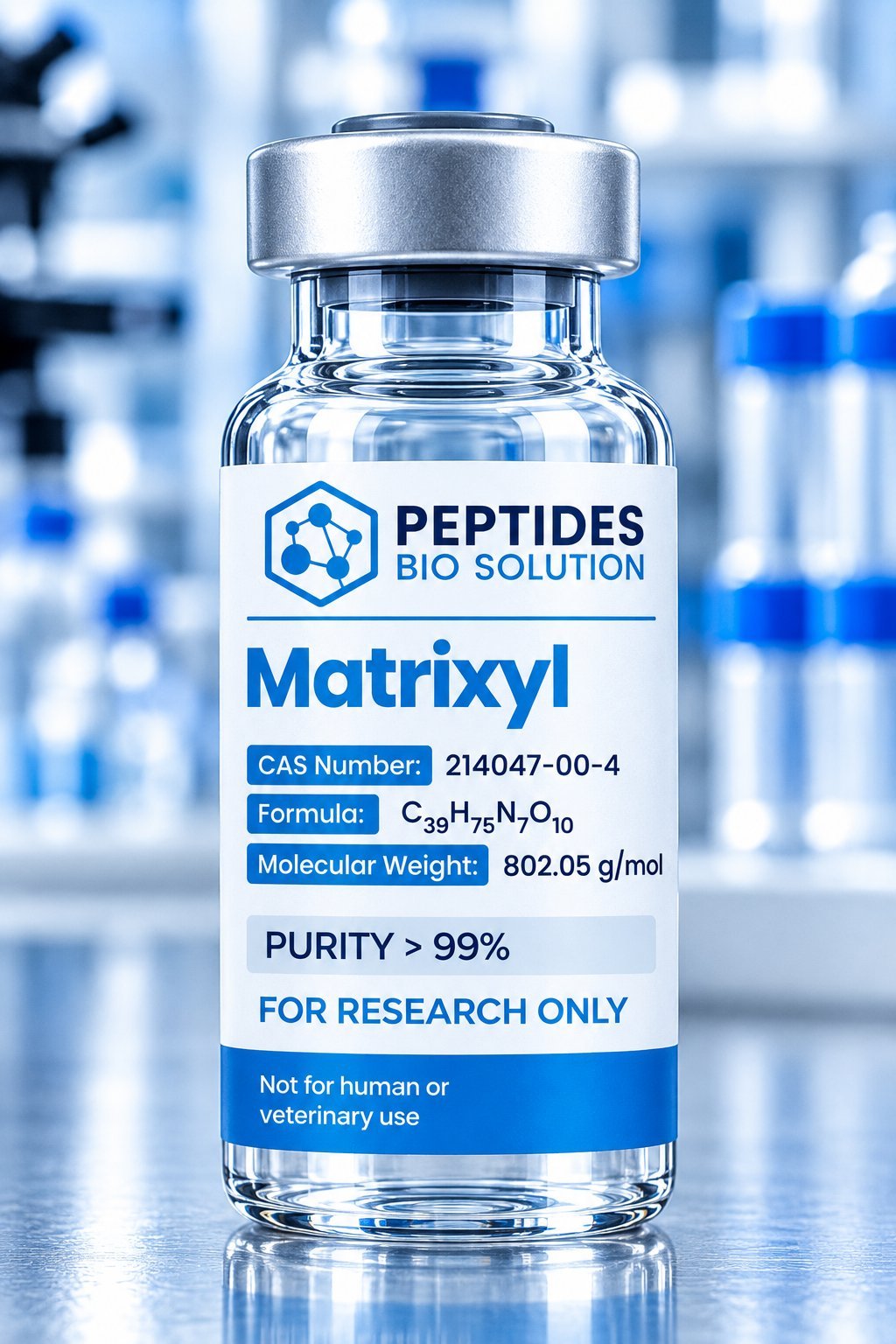
Matrixyl (200mg)
$185.00
Specifications
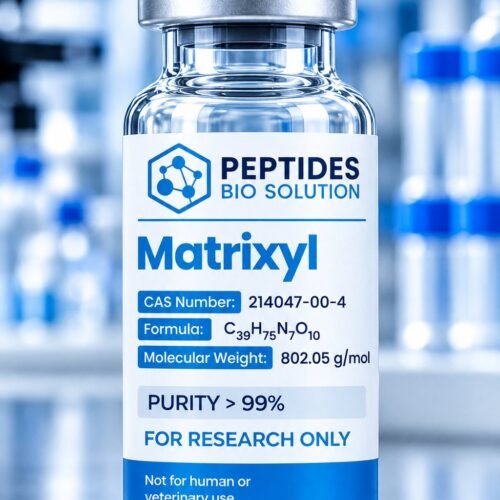
MOLECULAR WEIGHT: 802.05 g/mol
MOLECULAR FORMULA: C39H75N7O10
SEQUENCE: Pal-Lys-Thr-Thr-Ser-OH or Pal-KTTS-OH
SYNONYMS: palmitoyl pentapeptide-3
Did you like this product? Add to favorites now and follow the product.
(+800) 1234 5678 90 Start Live Chat
Description
Matrixyl Peptide
Matrixyl is a lipopeptide that combines fatty acids with amino acids. The peptide is also sometimes referred to as palmitoyl pentapeptide-4 or palmitoyl pentapeptide-3. The palmitoylated sequence of Lys-Thr-Thr-Lys-Ser-OH, which makes up the peptide, is posited to be a signal peptide fragment of the C-terminal propeptide of type I collagen.[1] Researchers report that “The conjugation with the palmitoyl moiety [may] result in more [impactful] delivery across the skin and better stability to skin proteases.” Overall, this signal peptide is posited to act as a stimulus to fibroblasts and stimulate them into producing extracellular matrix (ECM) proteins such as collagen. Therefore, Matrixyl is considered by researchers to be a matrikine – a messenger peptide capable of regulating cell activities by interacting with their specific receptors.
Specifications
MOLECULAR WEIGHT: 802.05 g/mol
MOLECULAR FORMULA: C39H75N7O10
SEQUENCE: Pal-Lys-Thr-Thr-Ser-OH or Pal-KTTS-OH
SYNONYMS: palmitoyl pentapeptide-3
Matrixyl Research
Matrixyl and Fibroblasts
Fibroblasts are cells responsible for producing collagen, a key structural protein in dermal tissues. When skin cells are exposed to varying amounts of Matrixyl, scientists have observed what appeared to be a concentration-dependent increase in collagen synthesis, particularly at concentrations near a specific threshold called the critical aggregation concentration (CAC).[2] The CAC is the concentration at which Matrixyl molecules begin to self-assemble into larger nanostructures. One possible explanation for the increased collagen production is that Matrixyl may self-assemble around the CAC, forming organized nanostructures like nanotapes or fibrils.
These formations are thought to present the peptide sequences in a configuration that supports their interaction with fibroblasts, potentially leading to increased collagen synthesis. The specific arrangement of peptides within these nanostructures might make it easier for fibroblasts to recognize and respond to them, thereby promoting collagen deposition. Interestingly, while Matrixyl seemed to reduce the rate at which fibroblasts divide—a process referred to as cell proliferation—the amount of collagen produced by each cell appeared to increase. This observation might suggest that Matrixyl encourages fibroblasts to prioritize collagen production over cell division.
Further research suggests that by potentially boosting collagen production by fibroblasts, Matrixyl might counteract the degradation of the dermal matrix associated with photoaging.[3] This degradation is often linked to the formation of wrinkles and a loss of skin structure elasticity. Therefore, Matrixyl may be a promising candidate for laboratory research focused on mitigating dermal cell photoaging by supporting the skin’s structural support through collagen synthesis.
Related products
Recently Viewed Products
Reviews
There are no reviews yet.